
Our History and Origins
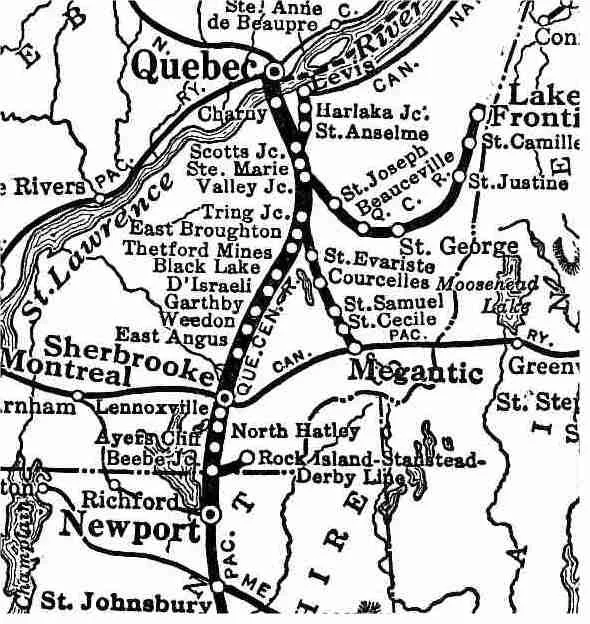
The Québec Central Railway (QCR) network on which we operate was completed between Sherbrooke and Lévis in 1881. In 1912, the rapidly expanding Canadian Pacific Railway signed a 999-year emphyteutic lease and became the operator of the railway network.
Subsequently, a new section extending from Vallée-Jonction to Lac-Frontière was opened in 1915. In 1921, another extension was built from Scott to Charny, providing direct access to the Québec Bridge and, as a result, to the north shore of the St. Lawrence River, eliminating the need to use the Lévis ferry crossing.
At its peak, the network stretched over 580 km.
Beginning in the 1980s, major North American railways underwent significant restructuring. This included large-scale workforce reductions and the abandonment of several regional lines deemed unprofitable or less profitable, such as the Tring Subdivision, dismantled in 1989, and the Massawippi Subdivision in 1992. Ultimately, in 1994, Canadian Pacific ceased all operations on the network, citing a lack of profitability due to competition from trucking.
In 1999, a regional businessman purchased the entire network from Canadian Pacific with the goal of revitalizing operations along its remaining length, with the exception of the Lévis Subdivision north of Saint-Anselme.
At the same time, in June 2000, the company Trains touristiques de Chaudière-Appalaches (TTCA) began operations on several scenic sections of the network. The company leased track access rights on the CFQC network from its owner. More than 97,000 passengers traveled through our beautiful region along the various branch lines. Unfortunately, due to a lack of track maintenance, the final departure took place on October 31, 2005. The trainset was later sold to other tourist operators outside Québec.
In 2007 and 2008, the Québec Ministry of Transport acquired the entire CFQC network, which was experiencing financial difficulties at the time. The owners of TTCA then began considering their options, including the possibility of entering the freight transportation sector when the time was right.
On December 10, 2013, after several years of reflection, the owners decided to relaunch the company in the freight transportation sector under the name Chemin de fer Sartigan. Operating the Scott–Lévis segment since that time, a major expansion is planned for early 2026, when the Scott–Thetford section will be reopened to rail traffic following extensive rehabilitation work.
This will allow businesses in the region to access a future-oriented mode of transportation that is competitive and generates significantly fewer greenhouse gas emissions.
For more information on the history of Québec Central, visit the Beauce Railway Museum.

Let’s work together
No matter the destination or origin of your goods, we support you from point A to point B throughout the entire transport logistics process